RELATION FORM+FUNCTION II
Form and function works together to achieve high performance in a building design, the interconnect relation between this two elements will enable longer lifespan for architecture.
How does it works?
For my understanding from Richard Hill, 'Purpose, Function and Use' are the relationship between, architect design purpose, function of its proposal (building itself), and how the users experience or carry out activities in that building.
Renovation, adaptive reuse, 3R (reduce, reuse and recycle) are those ways which affected a lot for the old and new building, very high contrast will happen between before and after. Contrast happen not only in space, it also show in event that in the building, for example : building renovated but function/activities still the same, building design is still the same but the function/activities changed, or both changed.

A compact design that challenges the typology of community library and student housing from both physical and social typology, L45. Situated in the heart of Bangsar, the corner house at Lorong Kurau offers much variation to the conventional design language of public. Ask anyone on the possibility of overlapping 2 functional spaces, a library and a student house, into a single space, one certainly couldn’t process the fine spatial line between the two spaces. According to online sources, the name is conceptualize as, L can stand for library, lot or lorong while 45 is the house number.
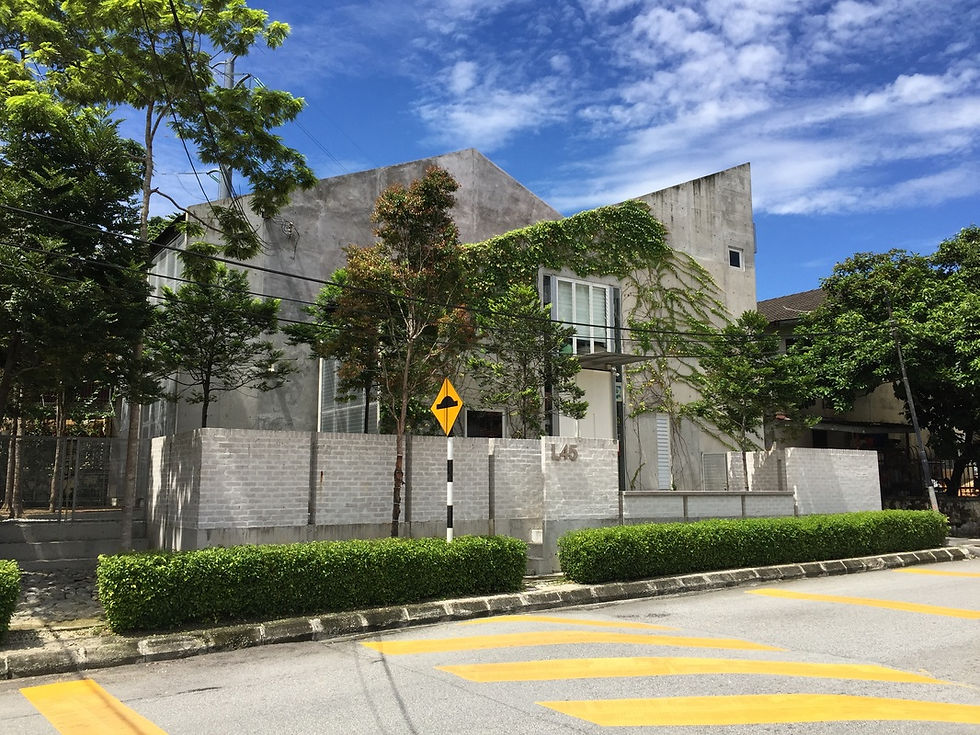
The client initially approached Tetawowe Atelier designers with a rough brief to design a student housing. He wanted to replicate his experience as a student in London, many years ago and to encourage a sense of community among students of different backgrounds. He also wishes to make it very simple. Something that is minimal and not loud, subtle yet functional. Since then, there has been integral changes to L45 as the designers further explore the brief by introducing a community library.
While the front half original portion is kept, the designers demolished the back half portion, and built a new extension following the profile of the original front half.
As it is intended to have 2 different spaces to coexist in the same place but yet, independent function of each other, the building has 2 different entrances. The entrance for the students is located at the narrow lane adjacent to the neighboring house, while the public entrances to the community library are the bare finished metal grill gates along perimeter that is easily accessed by public. Both of these 2 zones are separated by a secured door that can only be accessed by the students who have the card access.

From the section, the original 2 storeys is modified to become a 2-storeys + 2 mezzanines, creating 8 rooms with ensuite bath and a sizable public library under one roof. Through the interlocking of spaces,the designers were able to play with spatial versatility that encourages interaction in creating these intimate corners.


Pictures above show the library interior spaces, the entire building skin is built with concrete and with a large skylight opening.


Pictures above show the private student residence which is part of the entire
library.
________________________________________________________________________
"Space and events are founded in each other, and uses arise when space, activity and equipment mutually constitute one another, not when their merely intersect..."
- Richard Hill, "Purpose, Function, Use"
From case study L45, I can understand that the relation between building structure, spaces, scenario happen within building and humanism (user feeling and need) is bonding very strong. The designers from Tetawowe has transform a bungalow into the library with a design (purpose) which still suite to the surrounding context (bungalow residential), interior spaces (function) changed, as student residence and library (use). Students which stay inside and public visitor now can feel more significance of those particular spaces inside this library compare to the original bungalow. For a success design/building, the relationship between the elements above should assemble with each others to perform well in function.


Comments